
Crypto Scam Warning Signs: A Free Printable Checklist for Beginners
Crypto scams work because they feel real in the moment. This page puts the most common crypto scam warning signs into one simple checklist you can read in two minutes, print, or share with someone you care about.
Quick answer
The biggest crypto scam warning signs are: someone you've never met in person bringing up crypto, pressure to act fast, "guaranteed" or very high returns, a request for your recovery words, and a fee to withdraw your own money. If you see even one of these, stop and check before you send anything.
🖨️ Free to share and print. No sign-up needed. Teachers, librarians, credit unions and family members are welcome to print this checklist or share it in a class, newsletter or group chat. If you post it online, please link back to this page so people always get the latest version.
Educational only. Not financial advice. Here's how we research our guides.
The Crypto Scam Map: a free infographic to share
Scams change names, not playbooks. This one-page chart shows where crypto scams find beginners (DMs, dating apps, fake ads, phone calls, group chats and "free" offers) plus the 3-second test that stops most of them.
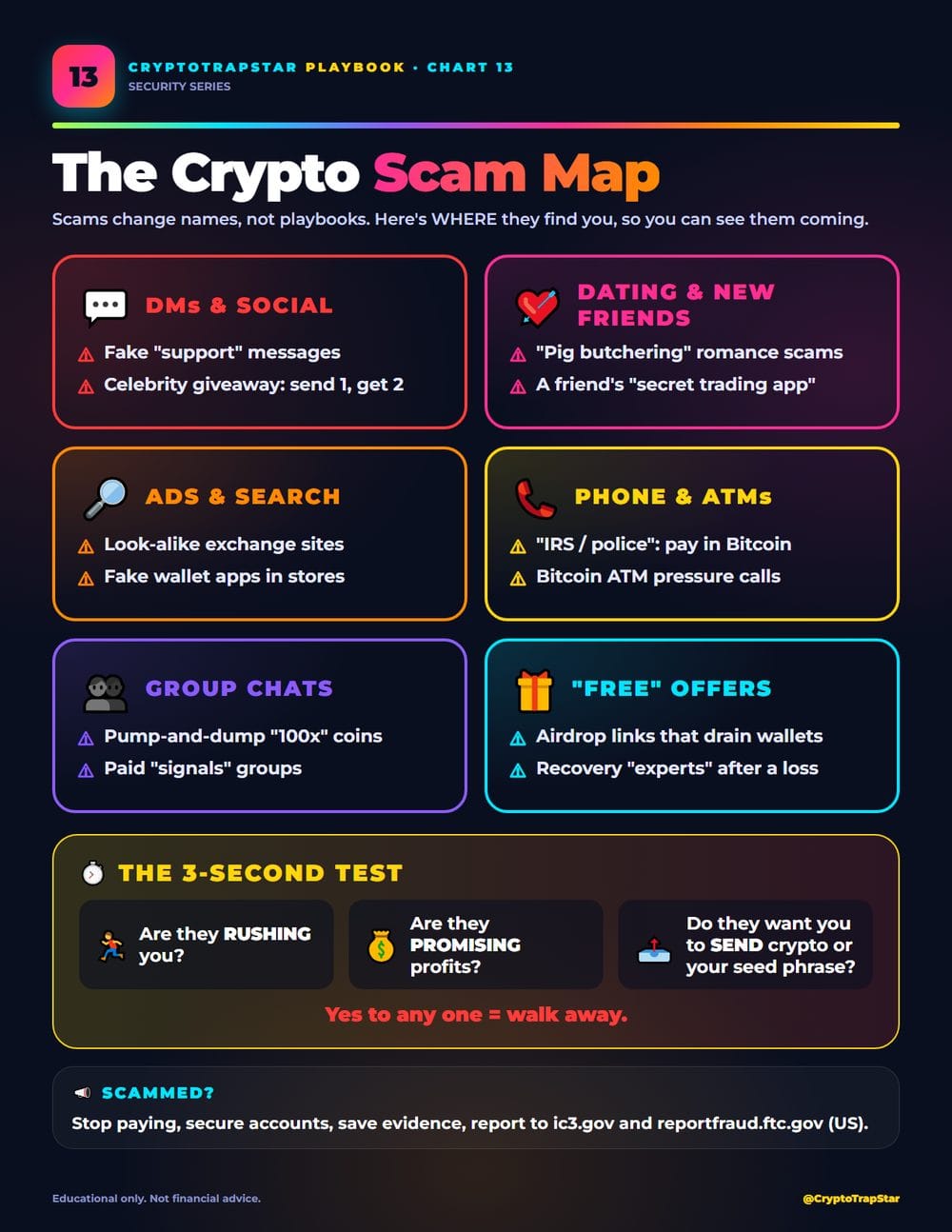
🔗 Free to share, print or embed. Save the image, print it for a class or group, or post it on your site. If you use it online, please credit CryptoTrapStar with a link to this page. To embed it, copy this code:
<a href="https://www.cryptotrapstar.com/blog/crypto-scam-warning-signs-checklist"><img src="https://d1yei2z3i6k35z.cloudfront.net/2121390/6ae8350c848458.16430703_crypto-scam-map.jpg" alt="The Crypto Scam Map infographic: where crypto scams find beginners" width="600"></a><br>Infographic by <a href="https://www.cryptotrapstar.com/blog/crypto-scam-warning-signs-checklist">CryptoTrapStar</a>
How do you spot a crypto scam? Use the 4 checkpoints
Most scams ask you to do one of four things: trust a stranger, click a link, send money or share a secret. Run the matching checks at each step. If any box is ticked, pause.
Checkpoint 1: Before you trust someone
- ☐ You've never met them in person, but they talk about crypto, trading or "the platform" they use.
- ☐ They found you first: a "wrong number" text, a dating app match, a friendly stranger in a group chat or a comment that turned into DMs.
- ☐ They claim to be from support, a government agency or a famous company and contacted you out of the blue.
- ☐ They say they can recover lost or stolen crypto for a fee.
Romance and "relationship" investment scams often take weeks of friendly chat before money ever comes up. The SEC's investor site explains how these relationship investment scams build trust first. For more real examples, see 7 Crypto Scams That Target Beginners.
Checkpoint 2: Before you click or download
- ☐ The link came in a text, email, DM or ad, not from typing the website address yourself.
- ☐ The app isn't from the official app store, or someone sent you a download link or asked you to install a "special" version.
- ☐ The website address is slightly off: extra letters, a hyphen, or a different ending than the real site.
- ☐ A message says your account is locked, hacked or about to close and you must act now.
Safer habit: go to any crypto site or app by typing the address yourself or using a bookmark you saved earlier, never through a link someone sent you.
Checkpoint 3: Before you send money
- ☐ Returns are "guaranteed" or sound too good to be true (daily or weekly profits, "can't lose" strategies).
- ☐ You're being rushed: a deadline, a "limited spot" or someone getting upset when you want to wait.
- ☐ You're asked to pay in crypto, gift cards or a wire to someone you don't know.
- ☐ You must pay a fee, "tax" or deposit to withdraw your own money from a platform.
That last one is a classic sign of a fake investment platform. The balance on the screen looks great, but the money was never really there. Real platforms don't hold your funds hostage until you pay more.
Checkpoint 4: Before you share anything
- ☐ Someone asks for your recovery words (seed phrase), private key or a photo of them. Anyone who asks is a scammer. No exception.
- ☐ Someone asks for your password or a 2FA code "to verify" or "to help."
- ☐ A website asks you to "connect," "validate" or "sync" your wallet to claim a reward or fix a problem.
- ☐ Someone wants remote access to your phone or computer to "help you set up" an account.
If you're not sure what recovery words are or why they matter so much, read What Is a Seed Phrase?
The 30-second rule
Before any crypto move, stop and ask yourself three questions:
- Who started this conversation? If it wasn't you, slow down.
- Am I being rushed? Real opportunities don't disappear in an hour.
- Would I be okay showing this to a friend or family member first? If not, that's your answer.
Taking 30 seconds to talk it over with someone you trust stops a lot of scams cold.
What should you do if you think it's a scam?
- Stop sending money, even if they promise it's the last fee.
- Don't share any more information, and don't click any more links they send.
- Save everything: screenshots of chats, wallet addresses, transaction IDs and website addresses.
- Report it to the FBI's Internet Crime Complaint Center at ic3.gov and to the FTC at ReportFraud.ftc.gov. Also tell the exchange or app you used.
- Watch out for "recovery" offers that show up afterward. They're often the same scammers coming back for more.
The Consumer Financial Protection Bureau also keeps a plain-English fraud and scams page with steps for protecting your money and accounts. If a lot of money is involved, it can also help to talk to your bank and, for legal questions, a qualified professional.
Quick recap checklist
- ☐ I started this conversation myself.
- ☐ Nobody is rushing me.
- ☐ Nobody promised guaranteed returns.
- ☐ I typed the website address myself or used my own bookmark.
- ☐ Nobody asked for my recovery words, password or 2FA code.
- ☐ I don't have to pay a fee to get my own money back.
- ☐ I talked it over with someone I trust.
If you can't tick every box, wait.
Frequently asked questions
What is the most common crypto scam?
Fake investment platforms are among the most common, often combined with a stranger who builds a friendship or romance first. The victim sees fake profits on a website or app, then is asked for more money or a "withdrawal fee." Nothing can actually be withdrawn.
Can you get scammed just by looking at a crypto wallet?
Simply viewing your balance is safe. The danger comes from what you approve: typing your recovery words into a website, connecting your wallet to an unknown site, or signing a transaction you don't understand. If you didn't start it, don't approve it.
How can I tell if a crypto website is real?
Type the address yourself or use a bookmark, check the spelling carefully, and download apps only from the official app store listing linked from the company's own website. Be extra careful with ads at the top of search results, since scammers sometimes pay for those too.
Can stolen crypto be recovered?
Sometimes law enforcement or exchanges can freeze stolen funds, which is why reporting quickly matters. But crypto transactions usually can't be reversed, and anyone who contacts you promising a guaranteed recovery for a fee is very likely another scammer.
How do I protect an older parent from crypto scams?
Print this checklist and go through it together, and agree on one simple rule: they call you before sending money to anyone they met online or over the phone. Scammers rely on secrecy and speed, so a quick family check-in is a strong defense.
🎁 Want the full beginner starter guide? My free guide adds the first-buy checklist, wallet basics and 21 crypto words in plain English. Download it free →
Educational only. Not financial advice. Crypto is volatile and you can lose money.
Sources & further reading
✍️ Written by Randy M., founder of CryptoTrapStar. Randy explains crypto and money basics in plain English for beginners, with a focus on buying safely, protecting your wallet and spotting scams. About Randy & CryptoTrapStar →
- Relationship investment scams, Investor.gov (U.S. Securities and Exchange Commission)
- Internet Crime Complaint Center (IC3), FBI
- ReportFraud.ftc.gov, Federal Trade Commission
- Fraud and scams, Consumer Financial Protection Bureau
Last reviewed: November 2, 2026. Found an error? Email hello@cryptotrapstar.com.
Start here
How to Buy Bitcoin Safely for Beginners
Step-by-step first buy
Where to keep your crypto
7 Crypto Scams That Target Beginners
Red flags to know
About this blog
CryptoTrapStar explains crypto in plain English for total beginners: how to buy your first Bitcoin safely, keep it secure and avoid scams. Educational only, never financial advice, no hype or price predictions.
Created with ©systeme.io